This short update outlines important developments on the AIIP Intergenerational Relationship Continuum, recent national child‑safeguarding reforms, and the work AIIP is leading to support members and strengthen intergenerational practice.
Intergenerational Relationship Continuum
When designed intentionally, intergenerational programs create protective environments where safety and mutual respect are part of everyday interaction. Intergenerational practice also plays a key role in safeguarding by building community cohesion, modelling respectful relationships, and giving both young and old opportunities to practise behaviours such as consent, communication, and boundary setting. As programs deepen into ongoing intergenerational connection, the aim is to maintain these protective environments and carry them into the broader community.
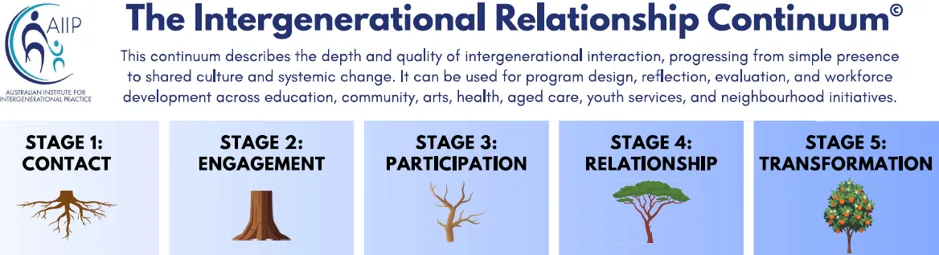
AIIP has refined the Intergenerational Relationship Continuum to more clearly describe and define the depth and quality of intergenerational interaction. The updated version includes a self‑assessment safeguarding tool linked to the Minimum Standards for Intergenerational Practice, supporting services to embed safeguarding across program and community settings. We look forward to sharing the continuum with all members shortly. A sneak peek provided below:
National Updates
Recent national changes include the introduction of mandatory national child safety training (delivered via the Geccko platform) and the establishment of the National Early Childhood Worker Register. These reforms are designed to strengthen safeguarding across Early Childhood Education and Care (ECEC), and their intent is strongly supported by AIIP.
As these changes roll out, AIIP members have raised questions about how the reforms apply, particularly in settings where older adults participate as community members rather than as workers. To support clarity and consistency, AIIP has established a working group and is developing a policy brief for decision makers that will:
- propose an evidence‑informed clarification recognising that, in some settings, older people may be classified as participants rather than workers
- outline how supervised participation models operate in intergenerational settings
- identify ways regulatory settings can support, rather than unintentionally restrict, community participation
We will keep members informed as we progress this work. AIIP members should continue to seek clarification from their relevant state or territory regulator if they are unsure of their responsibilities.
Intergenerational Safeguarding Resources and Training
AIIP is exploring the development of training and practical resources to support intergenerational safeguarding. This work will focus on helping services understand how safeguarding principles apply in intergenerational contexts, including how to recognise and respond to concerns and create safe, supportive environments for both children and older adults. Training may also cover the role of intergenerational connection in strengthening communication, trust, and protective behaviours across programs and community settings.
How you can help
To help us understand the kinds of resources and training members would find most useful, along with opportunities to strengthen adult and child safeguarding and wellbeing, we’ll soon be inviting all members to complete a short survey. AIIP will use this feedback to guide future work, including policy briefs and the development of training.