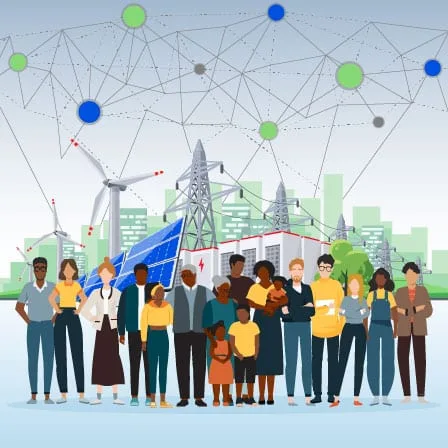
At the recent AIIP Professional Development webinar facilitated by Greg Cronan, Robert Fitzgerald AM encouraged members to consider how intergenerational practice can strengthen social capital (you can access a recording of the interview with Robert here).
In this short post, we unpack the idea of social capital and invite members to join the conversation.
What is Social Capital?
Social capital refers to the value that grows through relationships built on trust, reciprocity and connection. It emerges when confidence and trust develop between generations in programs, and in the broader sense of connection that extends into families, neighbourhoods, and community spaces. Expressions of social capital are interconnected, reflecting how relationships formed in one setting can strengthen belonging and participation in others.
Intergenerational practitioners often talk about the ripple effect. The way positive interactions between generations in structured and unstructured settings spread outward, strengthening trust, empathy, and participation. When older and younger people connect meaningfully, those experiences often influence others in their networks, creating waves of connection that build social capital across a community. The ripple effect reminds us that the impact of intergenerational practice isn’t confined to the participants; it extends to families, neighbourhoods, and organisations, shaping a culture of mutual respect and shared wellbeing.
A ripple in action
Recently AIIP partnered with Sarah Brady from The Community Crusade to pilot Book Buddies, supported by funding from the Qld Health and Wellbeing Grant. In the follow up survey with parents and students, one parent shared a story that beautifully illustrates the ripple effect. She explained that after the Book Buddies program had ended, her Year 3 child recognised one of the “grand friends” at church. He felt confident enough to walk over, say hello, and introduce his family.
That small moment shows how trust and connection built during the program can flow out into everyday life. It reflects the broader social capital that intergenerational practice can enable through growth in confidence, recognition, and a sense of belonging that extends into the wider community.
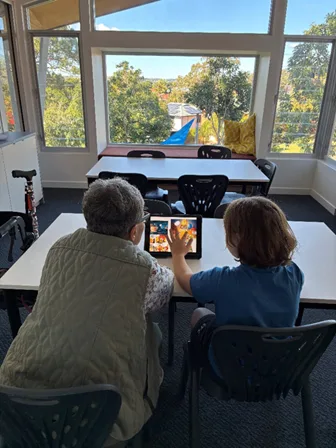
Caption: Week 7 Book Buddies: Reading with Tech. Shared with permission.
Stories are powerful. They reveal the human side of impact; the confidence, trust and connection that numbers alone can’t capture. Yet funders and partners often ask, “Yes, but how many people experienced this?” They look for tangible measures to sit alongside the stories. A challenge for us is to bridge that gap. To honour the richness of stories while also showing their reach and ripple effect in ways that can be seen and measured.
Here are some ways social capital might be measured:
Within the program
- Relational indicators: Capture trust, confidence, and belonging among participants through reflective activities, surveys, or observation.
- Shared participation: Observe and document how participants work together, offer support, and demonstrate reciprocity during program activities.
Beyond the Program
- Social network analysis: Used to understand how relationships extend beyond the program i.e. who connects, collaborates, or stays in touch.
- Ripple Effects mapping: Visualise stories of impact to reveal how trust and connection spread between people and communities.
We’d love to hear from members. What are your experiences with social capital in intergenerational work? How are you measuring it, and what questions or insights are emerging for you?
Further Reading
Brown, L., & Pangbourne, K. (2026). A Systematic Review of the Applications of Ripple Effects Mapping. International Journal of Qualitative Methods, 25, 16094069261432750.
Kim, J., & Chung, S. (2022). Is an intergenerational program effective in increasing social capital among participants? A preliminary study in Korea. Sustainability, 14(3), 1796.
Murayama, Y., Murayama, H., Hasebe, M., Yamaguchi, J., & Fujiwara, Y. (2019). The impact of intergenerational programs on social capital in Japan: a randomized population-based cross-sectional study. BMC Public health, 19(1), 156. Sánchez, E. Q., Gómez-Alonso, M. T., Ramos, N. A., Pinto-Carral, A., Reguera-García, M. M., & Fradejas, B. A. C. (2025). Physical Activity Practice, Life Satisfaction, and Loneliness Among Older Adults: A Study Based on Social Network Analysis Within an Intergenerational Framework. Journal of Aging and Physical Activity, 33(6), 529-535.