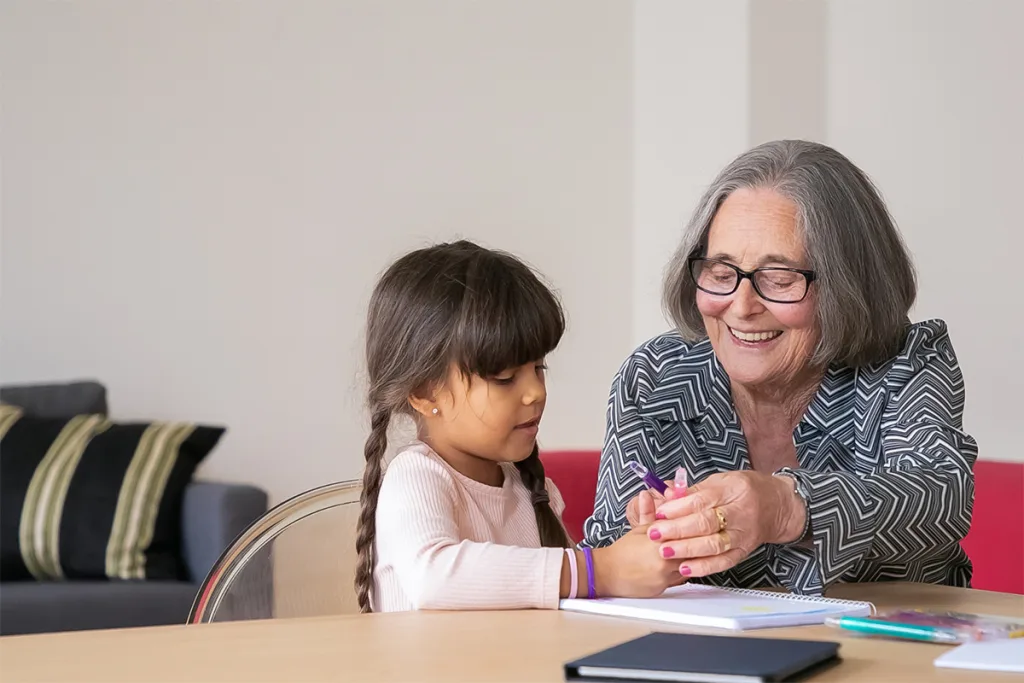
This week we chat with Rafaela Prado Umeno – Winner of the 2026 AIIP Intergernational Research Excellence Award.

Rafaela’s research will be of interest to practitioners exploring how intergenerational environments foster connectedness and human flourishing across ages. This Q&A also offers a compelling story for those considering further research in this field.
How did you first get interested in Intergenerational practice?
I initially volunteered for a program called the Visitors Community Scheme with the Multicultural Communities Council of the Gold Coast and started visiting an aged care facility. The first lady I was matched with was a lady named Joy – and she really was a joy. She was 95, and I’ll never forget how she could put on her lipstick, better than both of us, without even using a mirror.
Visiting was a reality check for me because I didn’t know how isolated and lonely so many older people can be. It’s a very nice facility, like a mid-scale hotel, four stars, I’d say, but coming in from the outside, you walk in, and you feel that grieving, that sadness, and that emptiness.
And I was there absolutely to address that social isolation and loneliness. I was only supposed to go every fortnight, but I just started popping in weekly and staying for at least an hour and a half. I just liked being there with them. Not having grandparents myself, it gave me something I didn’t realise I was missing. So I did that and that stayed with me, you know when you come out of the visits like, “oh, if only I could do something more”.
What made you decide to take the leap into a PhD focused on intergenerational work?
I applied for a PhD towards the end of 2020, because I could see with COVID starting that international students would not be able to come to Australia. So, it was time for a career change [Rafaela previously taught TESOL and managed the English Faculty of an RTO]. At the start, my research topic was really shaped by my background in hotel management, so I felt like I had to steer it towards tourism and hospitality. Initially, the topic wasn’t really centred on people living in aged care facilities. I started the PhD, and I was exploring topics and looking for a scholarship. And then one of my supervisors said to me, “Rafaela, what do you actually like? And I said, “look, I really want to do something meaningful for people, especially people that are isolated and lonely.” And she said, “well, I’m going to introduce you to Anneke Fitzgerald. I’m pretty sure you guys will have a nice chat.” And that day I met Anneke, I was just like, that’s what I want to do.
Can you tell us about your research?
My PhD is focused on understanding how intergenerational spaces provide opportunities for connectedness and human flourishing for older participants and younger children. Specifically, I looked at how affordances enable connectedness between older and younger people. Affordances come from Affordance Theory, which is really just about the opportunities the environment gives people for action and interaction.
For example, what can you do with a chair? Chairs afford sitting. If you leave those empty chairs, misaligned or scattered about, they’re not going to afford much more. But if you organise them in a circle, those chairs will afford conversations.

So, I looked at the environment, not from an architectural background, because I’m not an architect myself, but more from the point of view of the possibilities for connectedness and people to flourish together in that space.
What difference would you love to see your research make in the world?
As part of the PhD research contribution, I developed a Stakeholder Engagement Evaluation Tool for intergenerational spaces. This is a detailed tool designed to help organisations and practitioners assess how well they are engaging all stakeholders in an intergenerational space. It helps practitioner’s ask: What do we need to avoid? What do we need to rethink about?
Designing intergenerational spaces is complex, as you need to consider both children’s developmental needs and older adults’ health and safety needs, so having clear guidance matters. I hope this work also guides policy and better understanding about intergenerational spaces. We need to carry on with research in this field. It’s so important. Intergenerational practice helps people to stay active in society and have that sense of belonging.
I welcome opportunities to connect with researchers, practitioners, and organisations interested in this research (LinkedIn https://www.linkedin.com/in/rafaela-prado-umeno-b89722239/). My thesis is currently under examination and should hopefully be conferred by June 2026. Once conferred and after a one-year embargo, it will be available at https://research-repository.griffith.edu.au/home. For early access, contact Professor Jennifer Cartmel at j.cartmel@griffith.edu.au, who can provide a copy.
We congratulate Rafaela on the submission of her PhD Thesis and winner of Winner of the 2026 AIIP Intergernational Research Excellence Award!