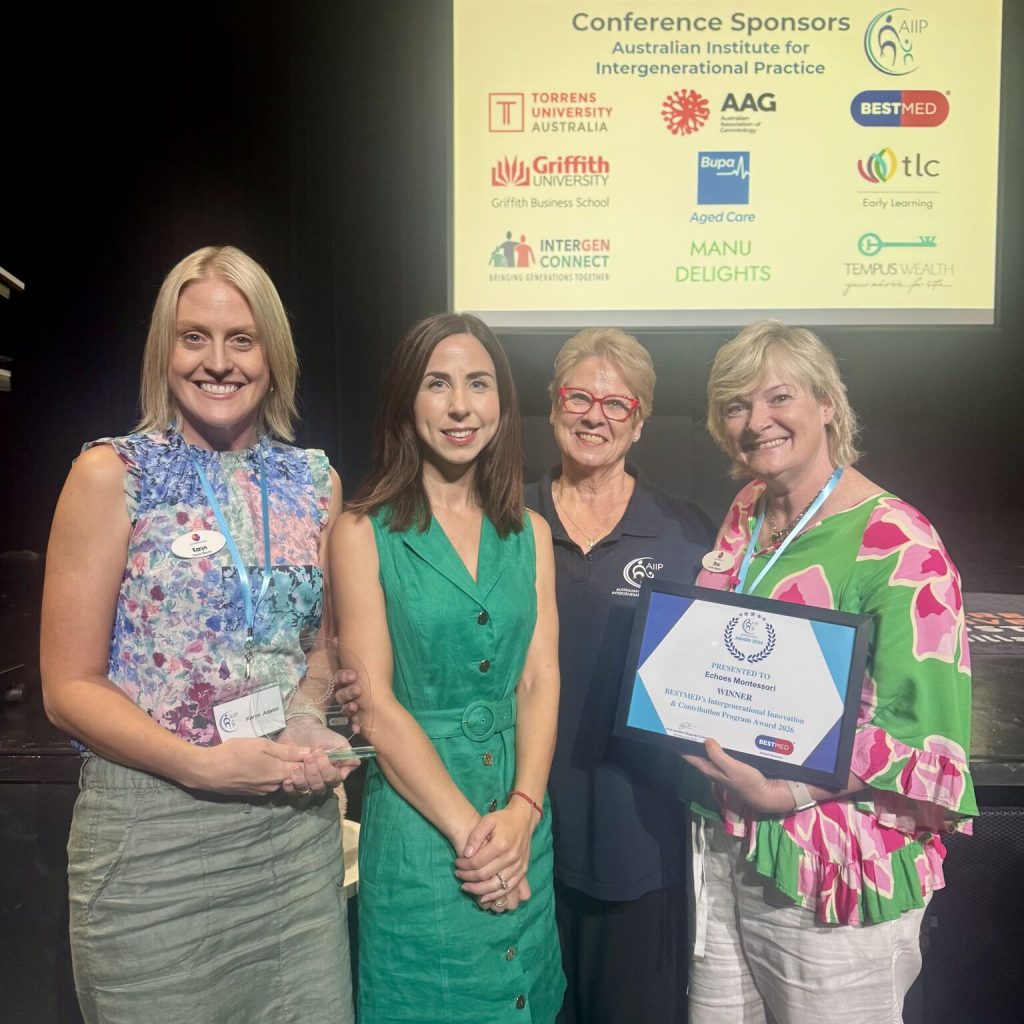
Curious about co‑designed intergenerational villages, Montessori approaches, or strengthening workforce capacity? We caught up with Jessica Langford from Echoes Montessori, the 2026 AIIP Innovation & Contribution (Program) Award winner to discuss these dimensions of intergenerational practice. Jessica’s insights invite reflection and open up space to think about what’s possible.
Can you tell us a little about the program?
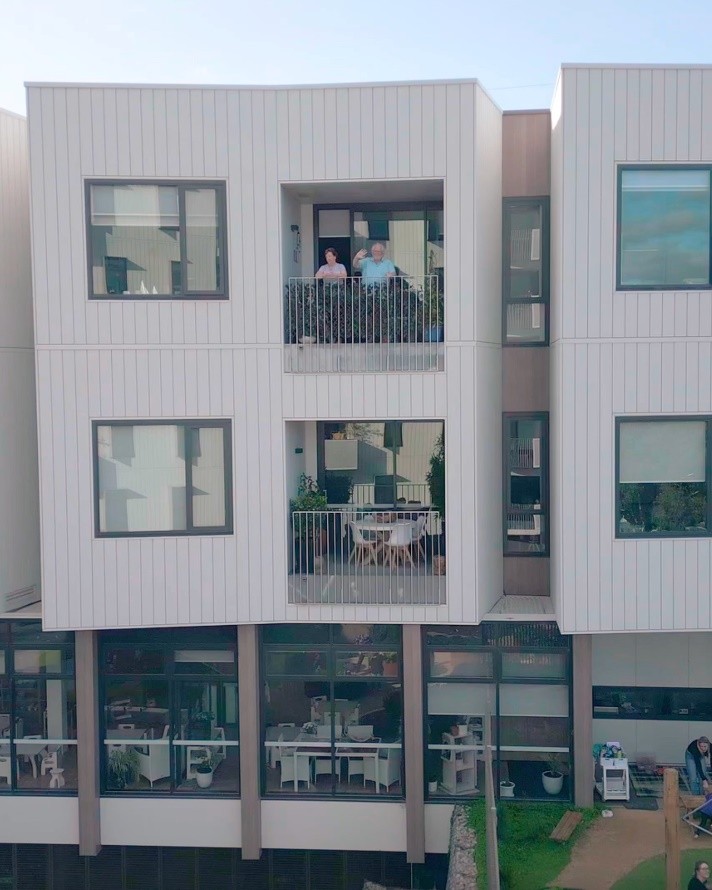
Echoes Montessori is the early learning environment set within the intergenerational village at Encore Apartments for independent retirement living. We partnered with ECH, who are an ageing support service in South Australia, to co-design the village from the very beginning.
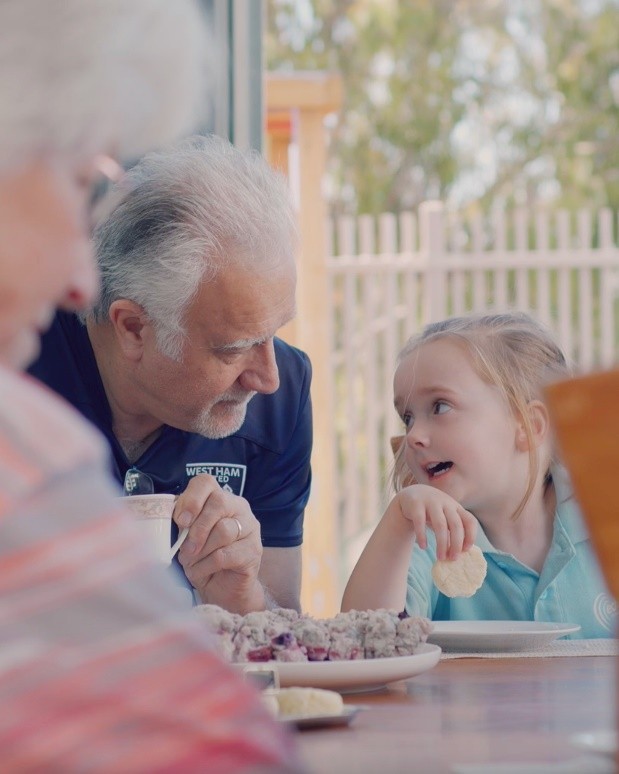
Within intergenerational practice we sometimes talk about the challenges of navigating between siloed departments or perspectives, but the co-design process knocked down those divisions and brought us all together. We were all sitting in the same room around the same table, putting those perspectives onto paper and kind of figuring out the tensions between ageing support and the early childhood perspectives and bringing in important philosophies like nature informed principles. So, even though we talk about it being an intergenerational program, or we talk about the discrete intergenerational activities that happen within Echoes Montessori, what we have at Encore Apartments is an intergenerational community. We’re here for each other if you need us, however it suits you. That’s one of the things I love about it. It’s so organic and it so allows for that personalised strength-based engagement, rather than, “okay, everyone, today, we’re all going to do this together”. You don’t have to fit into a structured, predetermined activity. Whoever you are, whatever your interests, that’s how you show up and we meet you there.
How did you become aware of intergenerational practice?
The seeds of appreciating intergenerational relationships happened subconsciously long before I was aware of it, because that’s how I grew up. I was extremely close to my Nanna and Grandad, Dorothy and Jack. When my Nanna was diagnosed with Alzheimer’s we felt very strongly that we wanted to support dignity and respect for her during that journey.
For any family who gets a diagnosis like that, it’s a learning curve. You suddenly are thrown into this whole new world where you’re trying to navigate this very cruel disease. And you’re trying to kind of piece it together and make sense of it medically and socially and in terms of health and safety. When Nanna moved into care, Grandad was there every single day before she woke up and until after she went to sleep so that she was never alone, she always had someone who loved her there. It was incredible to watch that dedication and that compassion and that tenderness that he would give her every single day.
But there were other people in her care facility who did not have an advocate or daily support from family. Even if they had loving, engaged families, not everyone has the capacity to be there every day. We were seeing so much loneliness and dissociation. But looking at Nanna, we were thinking, “why is her decline so much slower than some of the people in here who have the same illness and same sort of physical situation, but they’re getting sicker quicker?”
We started to investigate Montessori for aged care, pioneered largely by Dr Cameron Camp in the US, who we were fortunate enough to train with when he came to Australia with Alzheimer’s Australia. And then it was really through my Grandad, who would come into the preschool with us sometimes after my Nanna passed. He would teach the children sewing because he was a retired tailor, or he would just come in and sit with the children and chat with them. And that’s where we were going…okay, hang on a second, there is a Venn diagram of Montessori education and ageing support that was overlapping and also the children and the older people are overlapping. It’s not just putting the same practices into action as a professional; it’s that these two groups belong together in a way that is quite transformative.
My mum’s brother knew the then CEO of ECH, David Panter. Hearing mum talk so passionately about connections between generations and knowing it was through their parents that she’d been inspired, he arranged for her and David to have a coffee.
Mum explained her idea, and David mentioned they had a new vertical village they hadn’t started designing yet, and the partnership and co‑design process grew steadily from there. It literally began with a cup of coffee, a moment of pure serendipity, and Mum’s powers of persuasion.
Could you talk a little about the workforce, how did you embed intergenerational practice?
We started out with the co-founders and three leaders completing intergenerational training and we thought at that time that these people could role model and mentor others. That worked to an extent, but it became increasingly clear over time that we needed a more consistent approach to people understanding fundamental intergenerational principles. So we arranged for more of our team members to do the JOY course, which was very helpful.
We also recognised the need to clearly articulate our Montessori for Life philosophy and turn it into a practical framework that blended our leadership knowledge in best practice intergenerational engagement with core Montessori pedagogy. Because Montessori teachers already understand principles like for example, the Prepared Environment, we showed them how to apply those same skills to intergenerational work.
To create truly effective intergenerational practice, it needs to be consistent across the whole team, not dependent on one or two passionate champions. The more you can clearly articulate, “This is how we do things here,” the stronger and more sustainable your approach becomes. Ideally, everyone would complete JOY training, but if that’s not realistic, you still need an in-house induction and onboarding process that sets out your expectations, provides core intergenerational training, and ensures every staff member understands and applies the same approach.
So, you’ve just taken on the role as Chair of the AIIP Advisory Council – congratulations! What else do you have planned this year?
Well, let me start within Echoes itself. What we’ve been doing in the last 18 months is working with Connect ‘n’ Grow, which is a registered training organisation that partners with schools. We’ve now got adolescents who join in on the program. Some of them are doing their aged care qualification or their children’s services qualification. It’s really wonderful having adolescent involvement as well.
For myself, I’m very excited to be involved with the Advisory Council. The AIIP does so much for intergenerational practice and being able to give back to that feels really meaningful.
It’s going to take all of us, as a united front, to build a collective movement that can influence government and policy.
I’m also halfway through my MPhil, looking at how intergenerational practice affects practitioners, particularly their sense of meaning and purpose at work. Anecdotally, I see that it really does make a difference, and we know meaning boosts performance and retention. With the staffing pressures in aged care and early childhood, I can’t help thinking what if intergenerational practice is a solution to that?
I’ve been looking at intergenerational settings overseas and thinking to myself, I’d love to go and visit some of these. For instance, foster care situations built into intergenerational housing, or there are places in the Netherlands where university students can sign up to live in the home of an older person to support ageing in place. So, I decided a couple of months ago to put in a Churchill scholarship application this year!
Seeing how well the intergenerational village works and then looking at the housing crisis and the loneliness so many older adults face, I just think: we need more of these kinds of communities. Not just in residential aged care, but in independent living too, so that people stay connected long before they reach assisted living. Honestly, it makes me want to knock on every policymaker’s door and say, “I’ve got your housing and social connection solution!”
A very big thank you and congratulations again to Jessica.
If you’re looking to deepen your intergenerational practice, or have team members who would benefit from practical, confidence‑building training, the AIIP is trialling JOY Passport. It is a concise, essentials‑focused version of JOY 1 offered in 1‑hour weekly sessions across 5 weeks. To find out more, contact education@aiip.net.au.