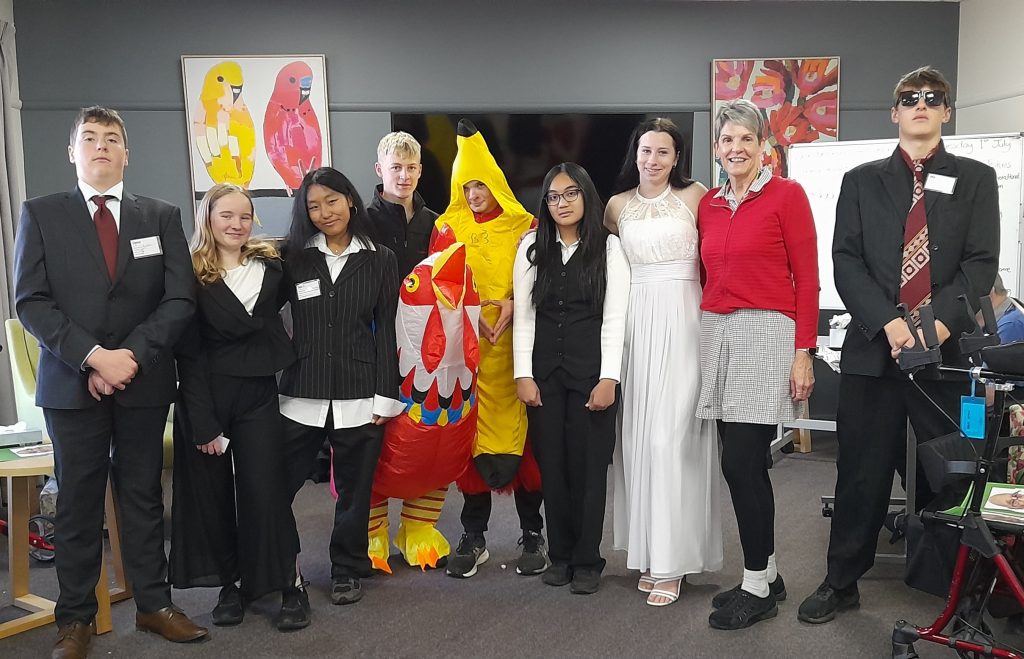
This month we are showcasing our 2026 AIIP Intergenerational Innovation and Contribution Program Award Finalists. We caught up with Rosemary Dax to chat with her about her nomination, to learn more about what first drew her into intergenerational work and the impact it’s having within her community.
Teens and the Time-Honoured (Myrtleford P12 College x Barwidgee Lodge – Alpine Health)
Rosemary began her career as an enrolled nurse in aged care but has spent the past 25 years working in primary health and prevention as a registered school nurse. Over the past decade, she has introduced a variety of intergenerational activities and programs.
Her story highlights the power of an idea, the impact of steadily chipping away at it, the importance of relationships and the alignment of intergenerational program outcomes with current government priorities.
What sparked your interest in intergenerational practice?
My Mum moved into care after she was diagnosed with Alzheimer’s and had a bad accident. Even though she couldn’t walk after fracturing her femur, she still wanted to help. She had so much wisdom to share, especially when my nieces visited with their babies. Simply sitting in the lounge was never going to be enough for her, she had spent her life as a maternal health nurse, and you could feel that knowledge sitting there, waiting to be used rather than wasted.
I thought, I’ve got all these young people, and I’ve got aged care facilities in my area. Why don’t I get that together instead of just thinking about it? It was pretty organic to start with, I would just take a small group down to visit, and the activities person would organise something. That grew to working with whole classes of year 9 and year 10 students. They would do one week of preparation at school and then the next week they’d go and present something or learn something from the residents.
Can you tell us a little about Teens and the Time-Honoured?
I take Year 9 students down to the residential aged care that’s attached to the hospital and we do activities. The Activities Coordinator is extremely passionate also, so that’s been fantastic. If the students are studying something, the teacher will talk with me about that, and I’ll let the activities people know, and we’ll try and incorporate that into the program.
A key learning from the AIIP JOY course, and from my own experience working with heath and within schools is the importance of developing and maintaining a solid relationship between the school and the health organisation. I had four boys and four girls attend last year. When I asked them why they signed up, the boys were very honest, they joined to get out of class! And then the first time they went, they got a tray of biscuits, so that kept them going. But then in all honesty the students grew to like it so much.
What are some of the benefits you’ve seen?
I’ve had kids with very little self-esteem and no confidence calling bingo in the aged care facility, which is no mean feat because you’re not allowed to say it wrong and you’re not allowed to be slow and you’re not allowed to be fast. Absolute growth just right before your eyes all the time. I don’t think you can develop empathy without doing things like this. I’ve watched kids without any input from me trying to help people participate. The older person might be in a princess chair and the student will say, “Do you want to have a go? I’ll help you throw it.”
When I asked students what they liked best about the programs, they all said the same thing: “When we walk in, their eyes just light up. They’re so pleased to see us”. I’ll often visit the Lodge on my own and older people will say: “Where’s the kids, Rosemary? When are the kids coming in?” One lady says to me all the time, “Oh, you do such a good job. We appreciate you so much. It makes such a difference to our lives.”
Another older person explained to me how she loves watching the way the students interact with each other. She said, “They come and they banter and they have a bit of a muck around and they trick each other and it makes me laugh and I just love it and I feel like I’m young again.” This got me thinking, and when I was interviewing one of the students, I shared these reflections and I also said, “At school you’re not in the same friendship group. You’re all individuals that have just come together for this. And yet you present up there like people that are close friends.” So, there’s another win, young people coming together forming connections they might never have made otherwise.
I asked one of the other students: “Do you think it made any difference to your life?” And he said, “Oh yeah, I hate school and I don’t like many teachers, but I always come to school on Tuesday because we were going to Barwidgee Lodge.” [At a time when school attendance is a clear government priority, this kind of impact feels especially powerful, illustrating how intergenerational connection can draw students in where traditional approaches sometimes can’t].
I told my Dad before he passed away that I did this in honour of Mum. A ripple effect was that although he would never have participated, he loved it. He would say to me on a Monday night, “Oh, how was the Lodge?” Because he knew I’d go down thereand I’d say “Oh, yeah, it was really good. And we did this, this and this …”
What are some of your hopes for intergenerational practice?
I’m trying to get school nurses in Victoria to see we’re in a very lucky space of being a conduit between schools and health organisations. It [intergenerational work] ticks all of the boxes for health promotion plans with a focus on supporting empathy and resilience in young people.
I’ve also got an intergenerational playgroup, that Year 8 students run with me on a Monday. We go down to the residents’ place, and we invite the community to attend. We’ll have waves where we have huge numbers and other times where we turn up and no families come, which mean no young children either. So I teach the kids, “we have to be resilient”. We’ll interview the residents or read books or do something else that day. I’ve had the news and the ABC radio come and of course people come out of the woodwork when they heard that! So that was a nice big turn up.
A big thank you to Rosemary and congratulations again on the nomination.
And please stay tuned for the 2027 awards, and consider applying to showcase and celebrate your work!